Charles Fort - The Harbour and the Stone
A calm Irish coastal fort song about Charles Fort above Kinsale Harbour, where star-shaped stone, sea wind, siege memory and quiet local history gather into one harbour melody.

County Cork • Place song
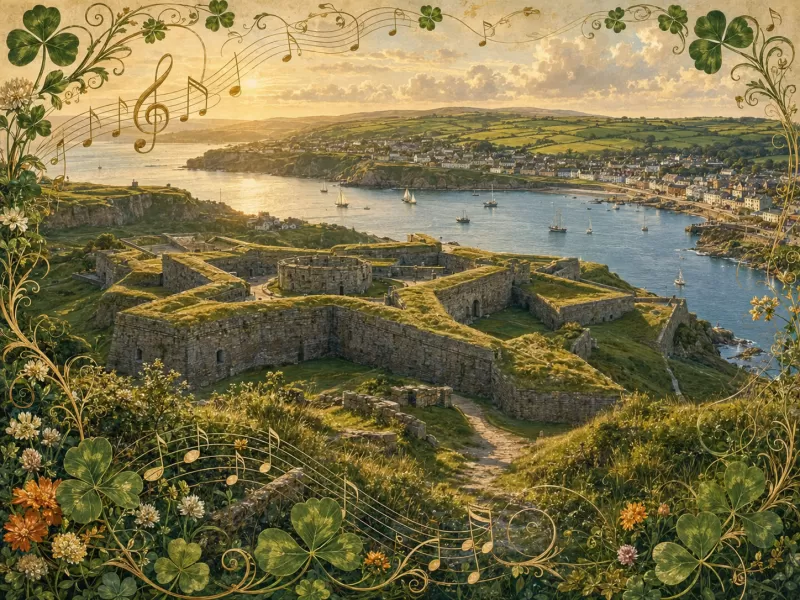
Charles Fort rises above Kinsale Harbour at Summer Cove, its star-shaped ramparts holding three centuries of coastal history. Built between 1677 and 1682 to defend the harbour, the fortress has witnessed siege, garrison years, Civil War fire and restoration. Today its stone walls, bastions and wide views towards Kinsale and James Fort offer a quieter experience: sea wind, water and difficult history remembered without spectacle.
A calm Irish coastal fort song about Charles Fort above Kinsale Harbour, where star-shaped stone, sea wind, siege memory and quiet local history gather into one harbour melody.
Place Story
Charles Fort stands at Summer Cove, on the edge of Kinsale Harbour in County Cork. From the ramparts, the view opens across the water towards Kinsale, the harbour entrance and James Fort on the opposite shore. The setting is one of the great strengths of the place: massive stone defences are softened by grass, changing Atlantic light, boats below and the constant movement of wind and tide. It is a fortress, but it is also unmistakably part of the living coastal landscape around Kinsale.
The present fort was constructed between 1677 and 1682 during the reign of King Charles II and is credited to the architect William Robinson. Its star-shaped plan and broad bastions belong to a period when military engineers designed fortifications to control approaches by land and sea. Charles Fort was built to protect Kinsale town and harbour, while the earlier James Fort guarded the other side of the water. Together they show how important this harbour was as a sheltered and strategically valuable place on Ireland's southern coast.
The walls have carried a difficult history. Charles Fort endured a thirteen-day siege during the Williamite Wars, remained a garrison for generations and was still occupied by the British army until 1922. During the Irish Civil War, retreating anti-Treaty forces burned the fort. These events matter, but they should be approached without turning the site into a celebration of conflict. The broken, repaired and weathered stone is more powerful when it is allowed to speak quietly about endurance, damage and the cost carried by real people.
Today Charles Fort is an OPW and Heritage Ireland visitor site where people can walk through the gateways, courtyards and ramparts and look back across the harbour. The experience joins architecture and landscape: high defences, open sky, salt air, old stairs, green slopes and water moving below. For Ireland in Song, this is the heart of the place. Charles Fort is not presented as a battle monument or a romantic ruin, but as a place where harbour beauty and serious history can be held together in clear, respectful memory.
LOCAL MEMORY
The local memory of Charles Fort begins with a contrast that can be felt before any date is learned. Kinsale Harbour can appear calm and luminous, with boats crossing the water and the town gathered beyond it, while the fort itself is built from heavy stone for watch, warning and defence. The song holds these two realities together. Its central image, "harbour and stone," is not only a description of the view; it is the meeting point between a beautiful living harbour and the difficult history carried by the walls above it.
That memory is best approached by walking rather than reenacting. Visitors move through grassed bastions, weathered passages and open ramparts while the sea wind passes through spaces once occupied by soldiers and guns. James Fort remains visible across the water, and ordinary harbour life continues below. The song's line "not every wall is shouting" gives the right tone: the fort does not need cannon fire, marching rhythms or heroic exaggeration to feel important. Its silence, scale and position above the water already carry enough weight.
The history of siege, garrison and Civil War burning is therefore remembered as human cost, not as spectacle. The lyric "let history stand clearly, let grief be spoken low" becomes the rule for the whole page. Facts should remain visible, but no side's suffering should be turned into entertainment or political chanting. The marks left by conflict belong beside the quieter image of morning returning to Kinsale and the harbour breathing again after every broken season.
For people who know Kinsale, Charles Fort is also part of the familiar shape of the harbour: a place seen from the water, approached through Summer Cove and revisited with family or visitors. Its memory lives in views, weather, footsteps and repeated return as much as in military dates. This is why the song ends with the fort keeping the harbour memory rather than winning a battle. Stone, water, sky and human remembrance become one local story, rooted in Kinsale and carried forward without denying what happened there.
LYRICS
Above Kinsale in evening light,
Where harbour waters shine,
The old walls hold the western wind
And keep their patient line.
At Summer Cove the ramparts rise,
Star-shaped over sea,
Charles Fort watches Kinsale Harbour,
Stone above the quay.
Built for cannon, tide and warning,
Under Charles's name,
It learned the weight of wind and years,
Of salt and cloud and flame.
Not every wall is shouting,
Not every stone is scarred;
Some keep watch in silence
And make the memory hard.
Charles Fort, Charles Fort, harbour and stone,
Standing by the water,
Weathered and alone.
Charles Fort, Charles Fort, under Kinsale sky,
The sea wind moves through old walls
And the years go passing by.
Robinson drew the lines of strength,
Wide bastions facing foam,
While James Fort kept the other shore
Across the harbour home.
Five arms held the seaward watch,
Flagstaff, Charles and North,
Kinsale light and Cockpit stone
Looking outward, looking forth.
Charles Fort, Charles Fort, harbour and stone,
Standing by the water,
Weathered and alone.
Charles Fort, Charles Fort, under Kinsale sky,
The sea wind moves through old walls
And the years go passing by.
Thirteen days the thunder circled,
High ground, smoke and rain,
Yet after every broken season
The harbour breathed again.
Garrison years and civil fire
Left their marks in stone,
But morning still returns to Kinsale,
Soft on wall and bone.
Let history stand clearly,
Let grief be spoken low;
No song should turn old suffering
Into a marching show.
For every hand that shaped the wall,
For every watch once kept,
The harbour holds a quieter truth
Where time and water slept.
Now visitors walk the ramparts,
Past the grass and weathered stair,
Looking out to James Fort's shadow
And the boats in harbour air.
For Charles Fort is more than battle,
More than names in stone;
It is harbour, wind and watching,
Kinsale's memory standing alone.
Charles Fort, Charles Fort, harbour and stone,
Standing by the water,
Weathered and alone.
Charles Fort, Charles Fort, under Kinsale sky,
The sea wind moves through old walls
And the years go passing by.
Charles Fort, Charles Fort, where the waters gleam,
Keep the harbour memory
Like a lantern in a dream.
Harbour and rampart, wind and rain,
Kinsale calls the light again.
Stone and water, sky and foam,
Charles Fort keeps the old road home.
By the harbour and the stone,
Charles Fort keeps the song.
Explore the project
From here you can return to the full Songs by Place directory, suggest another Irish place through Request a Song, or send local corrections and memories through the Contact page.
KEYWORDS
Community
Share your thoughts about this place, its story, the song, or your own visit.
Be the first to share your experience of this place and its song.